GUIDE — a proactive insulin regimen to prevent surgical site infections
Does treating postoperative hyperglycaemia proactively — with a basal-bolus insulin regimen — reduce surgical site infections in people with type 2 diabetes, compared to the reactive sliding-scale regimen most Dutch hospitals still use?
Led by Dr Sarah Siegelaar (Amsterdam UMC); I am a co-investigator and site coordinator, continuing the perioperative diabetes trial work from my PhD. Recruitment is ongoing across six participating centres.
The problem
People with type 2 diabetes face a substantially higher risk of surgical site infection (SSI) — the most common postoperative complication outside cardiac surgery, with a mean Dutch incidence of 2% but up to 18% depending on procedure. Poor glucose control is a well-established driver, and small studies suggest a proactive basal-bolus insulin regimen controls glucose better than the reactive sliding-scale regimen most hospitals still default to — but no adequately powered trial has tested whether that actually translates into fewer infections.
Design
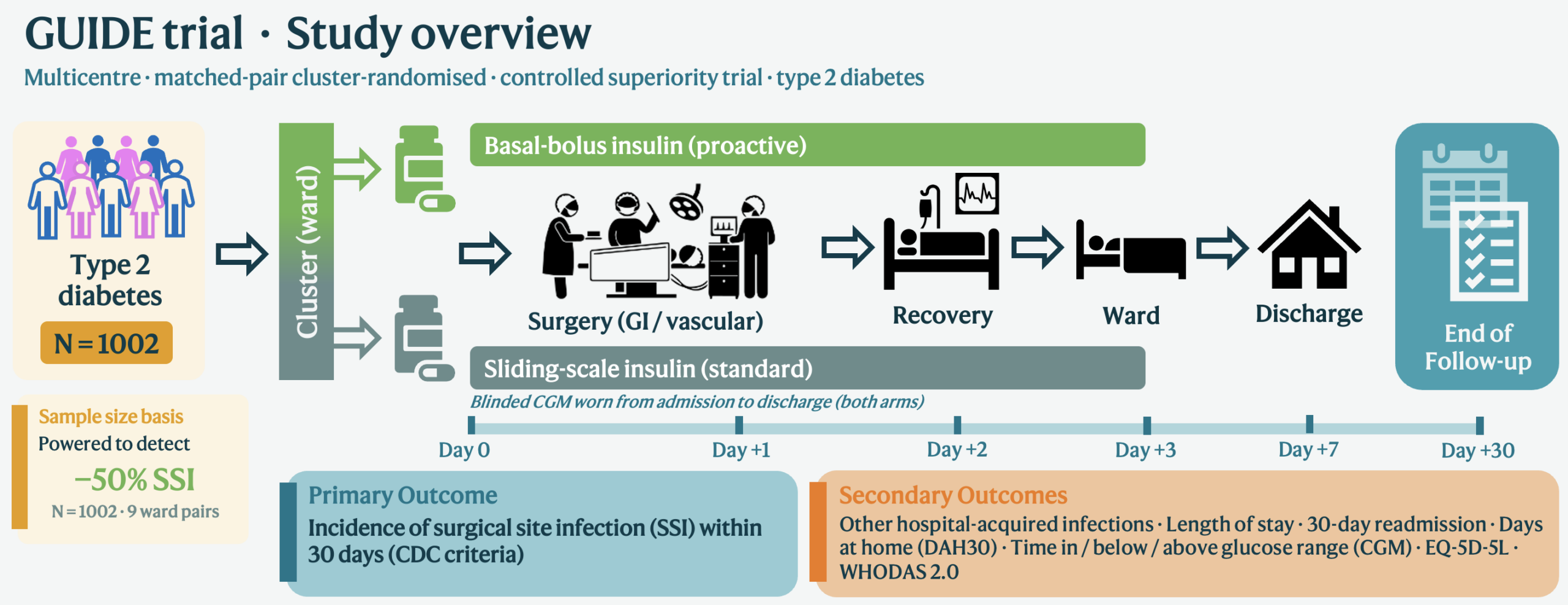
GUIDE is a multicentre, matched, cluster-randomised superiority trial: each surgical ward — not each patient — is randomised to one regimen, matched by hospital type (academic/peripheral), ward type (GI or vascular surgery), and expected inclusion rate. This maximises protocol adherence and avoids spill-over between patients on the same ward. All participants undergoing elective GI or vascular surgery wear a blinded continuous glucose monitor regardless of study arm.
Hypothesis & outcomes
Primary hypothesis: a proactive basal-bolus insulin regimen, targeting 3.9–10 mmol/l, reduces 30-day SSI incidence by 50% relative to a reactive sliding-scale regimen targeting the same range.
- Primary outcome: SSI incidence within 30 days of surgery.
- Secondary: hospital length of stay, 30-day readmission, days alive and at home at 30 days (DAH30), quality of recovery (QoR-15), health-related quality of life (EQ-5D-5L), disability (WHODAS 2.0), and healthcare costs.
- An embedded economic evaluation will assess cost per SSI prevented and per quality-adjusted life year gained.
Team & collaborators
Funded by ZonMw (Goed Gebruik Geneesmiddelen). Developed and supported throughout by the Dutch Diabetes Association (DVN), with implementation partners including the Dutch Internal Medicine Federation, the Dutch Society of Anaesthesiologists, ESAIC, PREZIES/RIVM, and the Surgical Infection Society Europe.
Where this leads
GUIDE sits on the glucose-control & diabetes line, alongside GLOBE, CGM screening work, and PRINCESS — separate from the kidney-protection line’s own ZonMw GGG grant, which funded MERCURI-2.