Perioperative diabetes drugs and kidney protection — answers to the questions I get most
I get a steady stream of emails asking some version of the same handful of questions: what to do with an SGLT2 inhibitor before surgery, whether to stop a GLP-1 agonist, how to run a patient’s diabetes on the day, and what — if anything — actually prevents kidney injury after cardiac surgery. This page collects my answers, drawn from the reviews I’ve co-authored and the protocols we use at Amsterdam UMC.
Not a guideline. This page is a fast, referenced starting point for common questions — it doesn’t replace your own hospital’s protocol or a case-by-case clinical judgement. I’ll expand it over time; it currently covers four areas I work on directly.
SGLT2 inhibitors around surgery
Do I still need to stop SGLT2 inhibitors before surgery?
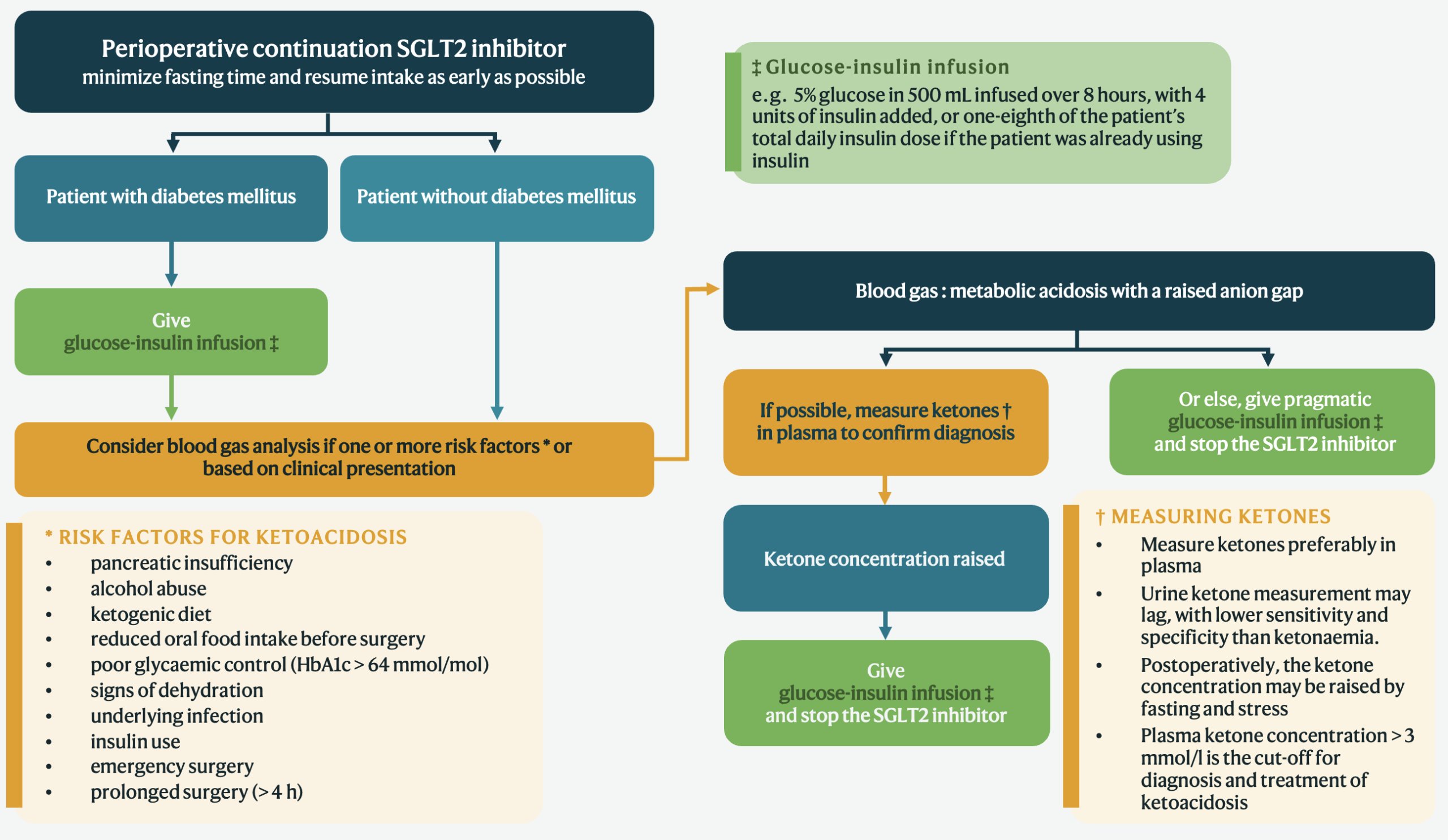
Guidance is shifting away from blanket withholding. US and European bodies have long recommended stopping SGLT2 inhibitors 3–4 days before surgery for fear of euglycaemic ketoacidosis, but the most recent multidisciplinary consensus statements now recommend continuation for minor procedures, and for major surgery in patients without diabetes or with concurrent heart failure or CKD. A large retrospective cohort of patients unable to stop their SGLT2 inhibitor before emergency surgery found no increase in ketoacidosis risk — one more data point favouring a risk-stratified approach over a uniform stop-everyone rule.1,2,3
My patient is on an SGLT2 inhibitor for heart failure, not diabetes — does that change things?
Yes, and I’d argue it pushes toward continuation. In the EMPEROR follow-up cohorts, patients withdrawn from long-term empagliflozin showed a rise in cardiovascular death and heart-failure hospitalisation within 30 days, alongside early increases in weight and NT-proBNP — signs that stopping the drug carries its own cardiovascular cost. Weighed against a ketoacidosis risk that’s low and manageable, continuation is often the better default in this group.2
How common is SGLT2 inhibitor-associated ketoacidosis, really?
Less common — and less clearly attributable — than the case-report literature suggests. In a systematic review my colleagues and I conducted of 128 published cases, an expert panel judged ketoacidosis a plausible consequence of SGLT2 inhibitor use in about 71% of cases; the rest were poorly documented or had a timeline that didn’t fit (ketoacidosis appearing days after the drug should already have cleared, for instance). Where it clearly did occur, insulin treatment resolved it in every surviving patient, though a substantial share needed ICU admission. Surgery itself raises ketone levels regardless of SGLT2 inhibitor use, which is part of why attribution is so often uncertain.3
If I do continue an SGLT2 inhibitor, how do I stop ketoacidosis becoming a problem?
Target the mechanism rather than the drug: minimise fasting time, resume oral intake as early as possible after surgery, and start a glucose-insulin infusion if the patient needs one. That’s the logic behind the algorithm we use locally (below). If ketoacidosis is suspected, check an arterial blood gas and plasma ketones rather than stopping the workup at “probably just fasting” — and treat with glucose and insulin.4
Is there any upside to continuing rather than stopping?
Beyond sidestepping the stop-and-restart medication errors that come with any perioperative drug hold, yes: SGLT2 inhibitors nearly halved the incidence of cardiac surgery-associated AKI in a small pilot trial (20% vs 66.7%), on top of their established cardiovascular and renal benefits. That finding is a large part of why I ended up researching this area — see NEPTUNE and STELLAR under Research.5,15
GLP-1 receptor agonists around surgery
Should I withhold a patient’s GLP-1 agonist before surgery?
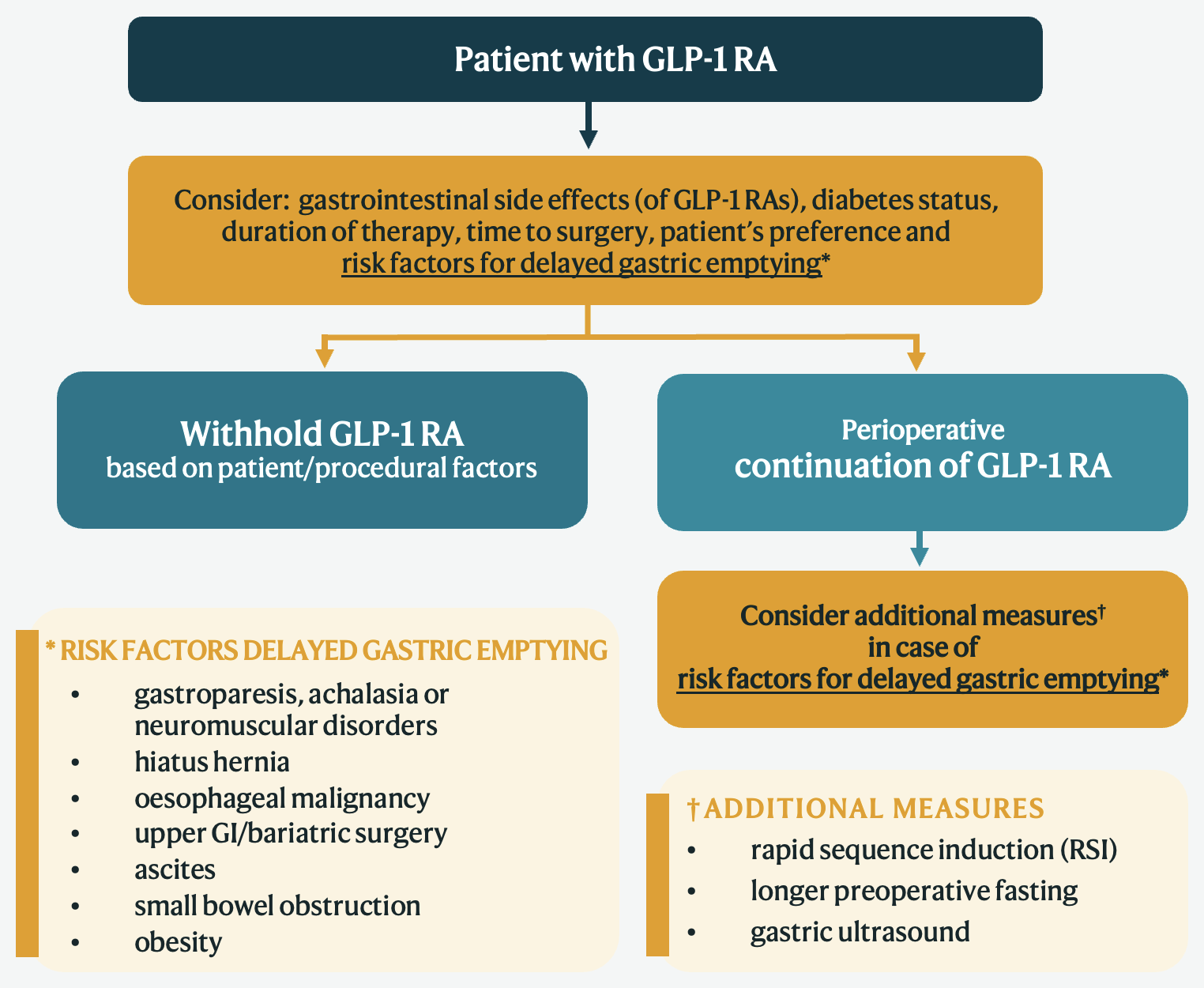
I don’t think routine withholding is well justified any more. The advice to skip a single dose is hard to reconcile pharmacokinetically — meaningfully clearing these drugs takes about three half-lives, which for the newer, longer-acting agents means weeks, not one skipped dose. More recent UK and US multi-society guidance has moved toward recommending continuation for most patients, with shared decision-making around aspiration risk rather than a fixed stop rule.6,11
What about the aspiration risk — isn’t delayed gastric emptying a real concern?
Real early in treatment, much less so later. The delay in gastric emptying is subject to tachyphylaxis: most pronounced in the first weeks of treatment, tending to normalise toward baseline after about 12 weeks. Observational endoscopy studies have found more residual gastric content in GLP-1 users, but the large cohort studies that actually looked at pulmonary aspiration during surgery haven’t found an increased rate. In my reading, the risk concentrates in patients who started treatment recently, not in long-term users.6,9
A patient started semaglutide six weeks ago and is booked for surgery next week — what do I do?
This is exactly the group I’d flag as higher risk, since it falls inside that early tachyphylaxis window. Consider the usual mitigating measures — a longer preoperative fast, a clear-liquid diet the day before, or rapid-sequence induction — rather than reflexively cancelling. If you want an objective read on gastric contents rather than guessing, gastric ultrasound is a reasonable bedside option, though it takes experience to interpret reliably.6,9
Is gastric ultrasound worth using routinely for these patients?
I’d use it selectively rather than routinely. It’s genuinely useful for getting an objective answer when deciding between proceeding as normal and a rapid-sequence induction, but the technique is more operator-dependent than it looks, and a single reading shouldn’t be the only thing driving that decision — dose, time since starting treatment, GI symptoms and the indication (diabetes versus weight loss) all matter too.9
Does it matter whether the GLP-1 agonist is prescribed for diabetes or for weight loss?
I think it should. Patients using a GLP-1 agonist purely for weight loss can usually tolerate a longer discontinuation if you want to be cautious, with little downside. Patients using it for type 2 diabetes are different: prolonged discontinuation risks perioperative hyperglycaemia, which can itself delay gastric emptying — working against the very outcome you were trying to protect.9
- Should I withhold a patient’s GLP-1 agonist before surgery?
- What about the aspiration risk — isn’t delayed gastric emptying a real concern?
- A patient started semaglutide six weeks ago and is booked for surgery next week — what do I do?
- Is gastric ultrasound worth using routinely for these patients?
- Does it matter whether the GLP-1 agonist is prescribed for diabetes or for weight loss?
Perioperative diabetes management, more broadly
Does every patient need a preoperative HbA1c check?
Guidelines increasingly say yes for anyone with known or suspected disturbed glucose metabolism, but I’d push back on using it as a universal screening tool for undiagnosed diabetes. In a cohort of almost 700 older adults without a diabetes diagnosis whom we screened before non-cardiac surgery, only 3.7% turned out to have undiagnosed diabetes, and HbA1c didn’t predict how well they did after surgery. Prediabetes, on the other hand, was very common (43%), though its clinical relevance in this setting is still unclear. I check HbA1c in anyone with known or suspected glucose problems; I’m less convinced it earns its place as a blanket screen in everyone.10,11
Should a high HbA1c actually postpone surgery?
Rarely, in my view. The link between a single high preoperative HbA1c and worse outcomes is mostly associative, not causal, and no trial has shown that lowering it before surgery changes anything. We also learned from the pandemic that postponing surgery carries its own real costs to patients. I’d use a high HbA1c as information to plan glucose management around, not as a routine reason to delay.11
Continue or stop metformin before surgery?
Continue, in almost all cases. The old fear of metformin-associated lactic acidosis doesn’t hold up well: in a randomised trial we ran, continuing metformin through surgery didn’t raise lactate to a clinically relevant degree, and it didn’t improve glucose control either — so there’s little to gain by stopping it, and little to fear by continuing it, in patients without significant renal impairment. The main exception is iodinated contrast with an eGFR under 60, where I’d omit it on the day and for 48 hours after.12,11
What glucose targets should I actually use during and after surgery?
On the day of surgery, avoiding hypoglycaemia matters more than chasing a tight number, since anaesthetised patients can’t report symptoms and a missed low is more dangerous than modest hyperglycaemia. I treat intraoperative glucose over 10 mmol/L with a correction dose or by adjusting a variable-rate insulin infusion, always alongside a glucose source to avoid an iatrogenic low. Practice varies more between hospitals than it probably should — a survey I ran of every Dutch hospital found real variability in glucose targets and insulin protocols, which is partly why I think having (and following) a clear local protocol matters more than debating the exact target number.11,14
Sliding-scale or basal-bolus insulin after surgery?
Basal-bolus, if you have the choice. Sliding-scale-only regimens — correction doses of short-acting insulin without a background long-acting dose — are associated with higher glucose values and more surgical site infections on the ward compared with basal-bolus regimens, which is why current guidance recommends basal-bolus as the default postoperative approach.11
Can patients keep using their insulin pump or continuous glucose monitor perioperatively?
Generally yes, unless there’s a specific contraindication such as MRI or an expectation of major fluid shifts. Manufacturers advise against use near imaging equipment or electrocautery, but switching a patient to multiple daily injections or an IV infusion introduces its own risk of dosing errors and coverage gaps. If a CGM stays in place, I’d still check fingerstick glucose periodically, since some perioperative medications can interfere with sensor accuracy.11
Preventing acute kidney injury after cardiac surgery
How big a problem is AKI after cardiac surgery, really?
Bigger than most non-specialists assume. Reported rates range from 5–40% depending on the type of surgery and the AKI definition used, and it’s the second most common cause of AKI in ICU patients after sepsis. It’s not just a marker of a rough operation either — patients who develop it have a roughly five-fold increased risk of later chronic kidney disease, and the excess mortality risk extends out to ten years after surgery.15
What’s actually driving it — in a sentence a non-nephrologist can use?
The kidney’s medulla sits at the edge of ischaemia even in health, because it needs high blood flow for filtration but tolerates very low oxygen tension. Cardiopulmonary bypass, aortic cross-clamping, haemolysis, and the drop in perfusion pressure below the kidney’s autoregulatory range during surgery all push it over that edge, compounded by the inflammatory and neurohormonal response to the operation itself.15
Are any of the newer biomarkers actually worth using?
Selectively. NephroCheck (TIMP-2/IGFBP7) and NGAL both give an early signal, hours before creatinine would rise, but neither is specific to the kidney or free of confounding — NGAL rises with inflammation from any source, and NephroCheck is affected by urine concentration. I see these as useful for flagging patients who need closer attention or trial enrolment, not as stand-alone diagnostics. Serum creatinine, for all its flaws (it lags real GFR loss and is affected by muscle mass), remains what most of us will actually use day to day.15
What actually reduces the incidence of AKI — anything?
Less than we’d like. Many plausible interventions — remote ischaemic preconditioning, nitric oxide supplementation, corticosteroids, sodium bicarbonate, high-dose vitamin C — haven’t held up in adequately powered trials. What has shown a signal: off-pump surgery where feasible, goal-directed perfusion targeting oxygen delivery, and — the area I work on — SGLT2 inhibition, which nearly halved AKI incidence in a small pilot trial and is now being tested in larger multicentre trials, including one of my own. Until that evidence matures, the KDIGO care bundle — avoiding nephrotoxic drugs, maintaining perfusion pressure, treating hyperglycaemia, close monitoring — remains the standard of care, and has itself been shown to reduce moderate-to-severe AKI when properly implemented.5,15,16
Where does your own research fit into this?
Two active lines: NEPTUNE is testing whether ketone supplementation protects the kidney through the same oxygenation pathway that seems to explain SGLT2 inhibitors’ effect, and STELLAR is a proposal to test whether a “functional renal reserve” test can catch subclinical kidney injury early enough to prevent it turning into chronic kidney disease. Both build directly on the prevention work above — see Research for details.15
References
- Dixit AA, Bateman BT, Hawn MT, Odden MC, Sun EC. Preoperative SGLT2 inhibitor use and postoperative diabetic ketoacidosis. JAMA Surg 2025;160:423–30.
- Oosterom-Eijmael MJP, Hermanides J, van Raalte DH, Hulst AH. Risk of perioperative discontinuation of SGLT2 inhibitors. Br J Anaesth 2024. doi:10.1016/j.bja.2024.05.004
- Snel LIP, Li X, Jamaludin F, et al. A systematic review and expert evaluation of perioperative SGLT2 inhibitor-associated ketoacidosis case reports. Acta Anaesthesiol Scand 2026;70:e70254. Open access →
- Stobbe AY, Oosterom-Eijmael MJP, de Galan BE, Hermanides J, Siegelaar SE, Hulst AH. GLP1-agonisten en SGLT2-remmers: stop ze niet rond een operatie. Ned Tijdschr Geneeskd 2025;169 (Dutch, subscription).
- Snel LIP, Oosterom-Eijmael MJP, Rampanelli E, et al. The effects of sodium-glucose transporter 2 inhibition on cardiac surgery-associated acute kidney injury: an open-label randomized pilot study. J Clin Anesth 2025;103:111811.
- van Zuylen ML, Siegelaar SE, Plummer MP, Deane AM, Hermanides J, Hulst AH. Perioperative management of long-acting glucagon-like peptide-1 (GLP-1) receptor agonists: concerns for delayed gastric emptying and pulmonary aspiration. Br J Anaesth 2024. doi:10.1016/j.bja.2024.01.001
- Hulst AH, Polderman JAW, Siegelaar SE, van Raalte DH, DeVries JH, Preckel B, Hermanides J. Preoperative considerations of new long-acting glucagon-like peptide-1 receptor agonists in diabetes mellitus. Br J Anaesth 2020. doi:10.1016/j.bja.2020.10.023
- van Zuylen ML, Hermanides J, Hulst AH. Preoperative continuation of GLP-1 receptor agonists. Response. Br J Anaesth 2024;133:882–3.
- Hulst AH, Hermanides J, van Zuylen ML. Residual gastric content and peri-operative semaglutide use assessed by gastric ultrasound. Anaesthesia 2025;80:333–342.
- van Wilpe R, van Zuylen ML, Hermanides J, DeVries JH, Preckel B, Hulst AH. Preoperative glycosylated haemoglobin screening to identify older adult patients with undiagnosed diabetes mellitus. J Pers Med 2024;14:219. Open access →
- Polderman JAW, Hermanides J, Hulst AH. Update on the perioperative management of diabetes mellitus. BJA Education 2024;24(8):261–269. Open access →
- Hulst AH, Polderman JAW, Ouweneel E, Pijl AJ, Hollmann MW, DeVries JH, Preckel B, Hermanides J. Peri-operative continuation of metformin does not improve glycaemic control in patients with type 2 diabetes: a randomized controlled trial. Diabetes Obes Metab 2018;20:749–752.
- Hulst AH, Preckel B, Hollmann MW, DeVries JH, Hermanides J. Preoperative continuation of oral hypoglycemic drugs (letter). Anesth Analg 2019.
- Hulst AH, Hermanides J, Hollmann MW, DeVries JH, Preckel B. Lack of consensus on the peri-operative management of patients with diabetes mellitus. Eur J Anaesthesiol 2019;36:168.
- Oosterom-Eijmael MJP, Hermanns H, Lankadeva YR, Hulst AH. Cardiac surgery-associated acute kidney injury. BJA Education 2025. Open access →
- Zarbock A, Kullmar M, Ostermann M, et al. Prevention of cardiac surgery-associated acute kidney injury by implementing the KDIGO guidelines in high-risk patients identified by biomarkers: the PrevAKI-multicenter randomized controlled trial. Anesth Analg 2021;133:292–302.