MERCURI-2 — testing SGLT2 inhibition against acute kidney injury after cardiac surgery
A multicentre, randomised, placebo-controlled trial asking whether a short perioperative course of dapagliflozin — an SGLT2 inhibitor — reduces the incidence of acute kidney injury (AKI) after cardiac surgery.
Funded by ZonMw (Goed Gebruik Geneesmiddelen), project number 10140022010003. Registered at ClinicalTrials.gov, NCT05590143. If you took part and left your email on the consent form, you should already have been informed of the results by the study team; see the summary below.
The problem
Acute kidney injury is one of the most common major complications after cardiac surgery and is associated with significant postoperative morbidity and mortality. No effective therapy currently exists to reduce its incidence. SGLT2 inhibitors have shown renoprotective signals in other populations independent of their glucose-lowering effect, so we hypothesise that perioperative SGLT2 inhibition will reduce the incidence of AKI after cardiac surgery.
Design
A multicentre, randomised, placebo-controlled, triple-blinded superiority trial. We aim to include 784 patients undergoing cardiac surgery, aged 18–90, randomised 1:1 and stratified by sex and type 2 diabetes status. Participants receive either dapagliflozin 10mg or placebo from the day before surgery until two days after. The primary outcome is the incidence of acute kidney injury according to the KDIGO (Kidney Disease: Improving Global Outcomes) criteria.
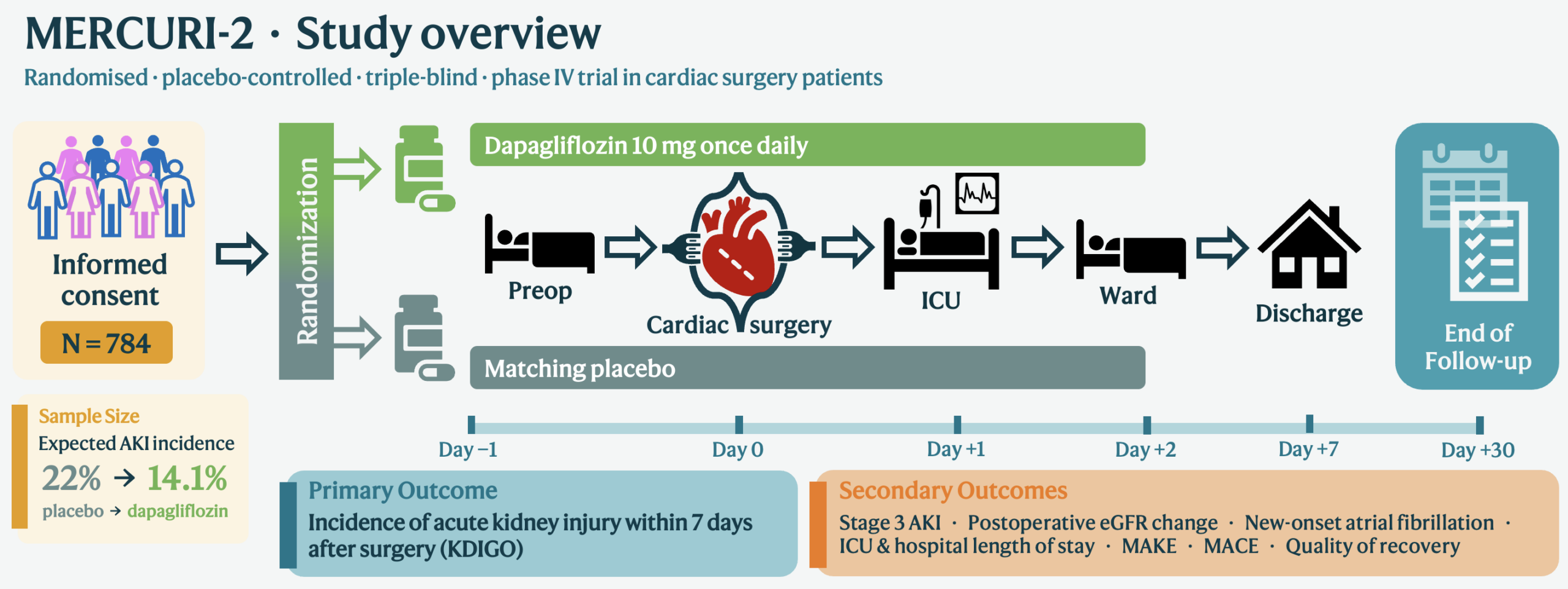
Progress
Enrolment completed on 27 January 2025, with all 784 participants randomised across the trial’s seven centres. Final follow-up was completed on 16 May 2025. The manuscript was published in JAMA on 30 July 2026 — see Results below.
Results
Published in JAMA on 30 July 2026. Among 784 randomised participants, dapagliflozin reduced the incidence of postoperative acute kidney injury compared with placebo over the 7-day follow-up period.
Relative risk 0.54 (95% CI, 0.45–0.65; P < .001)
Rates of secondary outcomes — including new atrial fibrillation, major adverse cardiac and kidney events at 30 days, length of hospital stay, and quality of life — were similar between groups, as were adverse events.
Citation Oosterom-Eijmael MJP, Hulst AH, Monteiro de Oliveira NP, et al; MERCURI-2 Study Group. Dapagliflozin and acute kidney injury following cardiac surgery: a randomized clinical trial. JAMA. Published online July 30, 2026. doi:10.1001/jama.2026.9268
Participating centres

Amsterdam UMC
Amsterdam, the Netherlands
Tahira El Benhaji, Catherine S. C. Bouman, Naomi Chen, Thomas G. V. Cherpanath, Giel Cox, Marcel G. Dijkgraaf, Nimrat Grewal, Hilde Herrema, Nathalie J. Huizing, Robert J. M. Klautz, Lars G. Knaap, Wil G. Kopatz, Marcella C. A. Müller, Abigail J. Murray, Frederique Paulus, Gabriela L. Pieters, Jorinde A. W. Polderman, Merlijn Reijrink, Abby Roest, Cato Schmitz, Youri Schut, Lars I. P. Snel, Nick G. Steijn, Ayla Y. Stobbe, Hajar Taârnit, Luuk T. Tegel, Divya P. R. Tika, Imran Uddin, Denise P. Veelo, Alexander P. J. Vlaar


OLVG
Amsterdam, the Netherlands

Leiden University Medical Center
Leiden, the Netherlands
Eline F. Bruggemans

Amphia Hospital
Breda, the Netherlands
Maaike S. Y. Thio, Michelle Verhagen

Medisch Centrum Leeuwarden
Leeuwarden, the Netherlands

Isala
Zwolle, the Netherlands
Yvonne J. Jordens, Alice C. Pap, Martijn Tolsma, Henrico J. F. T. Wesselink

Medisch Spectrum Twente
Enschede, the Netherlands
The MERCURI-2 Study Group also gratefully acknowledges the contribution of Nardo J. van der Meer (Catharina Hospitals, Eindhoven).
Associated organisations

ZonMw


Where this leads
MERCURI-2 is the confirmatory trial that followed the MERCURI-1 pilot, and its own ZonMw GGG grant sits alongside the separate GGG grants that fund GUIDE on the glucose-control line and MERCURI-3 on this line. MERCURI-3 takes the question further, asking whether patients already on an SGLT2 inhibitor should continue it through surgery rather than start one beforehand. Its urinary-oxygenation sub-study also feeds directly into NEPTUNE.